To be Jewish and LGBTQIA+ in today’s Europe often means belonging to two beautiful, yet intricate, mosaics whose pieces occasionally fail to fit together. We live in between: too queer for some Jewish spaces, too Jewish for certain queer ones. But in that space of tension lies possibility: the chance to build bridges where walls have long stood.
Keshet: From a Network to a Movement
My Hebrew is terrible, but I do know one thing: Keshet means rainbow. And that already says a lot. The rainbow symbolises diversity, pride, and hope for the LGBTQIA+ community. In Jewish tradition, it’s also a sign of connection, a bridge between earthly realm and divine. That’s exactly what Keshet Europe strives to be: a bridge between communities, between LGBTQIA+
and Jewish identities.
When we founded Keshet Europe in 2025 as a pan-European network of LGBTQIA+ Jewish individuals and organisations,
our dream was to build a space where our Jewishness and queerness could not only coexist, but thrive in harmony.
We built it not to ask for belonging, but to affirm that we already do.
Keshet Europe was born not only from vision, but also from necessity, from the urgency of the events that were unfolding around us. In recent years, Europe has witnessed a rise in both antisemitism and anti-LGBTQ+ sentiment: from hate speech spreading more openly online, to physical attacks on Jewish institutions, to discriminatory laws and social hostility targeting queer people in several countries. These are not abstract trends, but daily realities that affect how safe we feel: for Jewish people, simply walking to a place of worship or wearing a Star of David; for queer people, facing harassment or threats
in public, accessing healthcare, or using public facilities safely.
For those of us who are both queer and Jewish, these pressures do not exist separately; they overlap, intensify one another, and often leave people feeling isolated or forced to choose between parts of their identity.
As challenges to both queer and Jewish identities grew louder across Europe, it became clear that we needed a space to stand together and to support one another.
What began as a network quickly became a movement. The response made it clear that there wasn’t just a need
for this movement, there was a hunger for it.
That hunger shaped our mission: to foster Jewish queer life, to fight antisemitism within the LGBTQIA+ community,
and to challenge anti-queer discrimination within the Jewish one.
And through it all, we lead with pride and with joy, because being part of our community is not only about surviving;
it’s about celebrating. Being both Jewish and queer isn’t just okay. It’s beautiful, powerful, and joyful.
But visibility alone isn’t enough. Building community means building trust, learning to speak a shared language,
bringing people together across many differences, and balancing countless perspectives.
Being both Jewish and queer carries a history of marginalization, but also a responsibility to ensure that no one is left behind.
Pride and Power
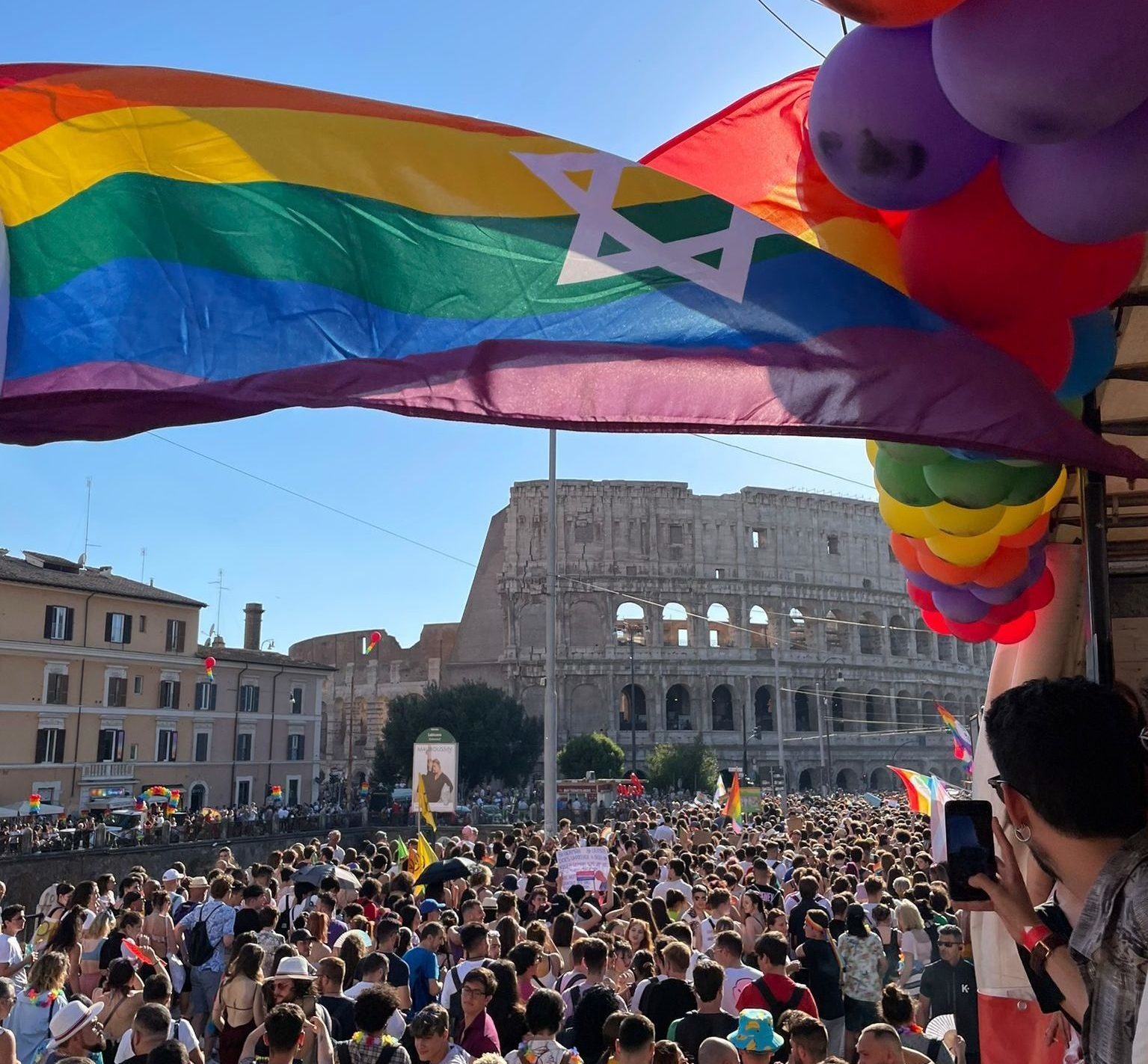
Our first participation at Rome Pride in 2025 made this truth impossible to ignore: being visible as Jewish and queer in today’s Europe is still a radical act. For years, local Jewish LGBTQAI+ organisations across Europe had been unable to march in Pride events, often because safety wasn’t guaranteed, or because there was simply no space for them. Our presence in Rome marked a turning point: a return to the streets together as a pan-European community and a declaration that our voices
belong here.
Marching with our flags held high, the colours of our queerness intertwined with our Jewish symbols, we faced hostility.
Some could not imagine queerness and Jewishness standing side by side.
Throughout the entire parade, the atmosphere around us remained tense. Along the route, people hurled insults,
some performed Nazi salutes, and others pointed their fingers at us like guns. From one of the floats, we were even shouted
at and labelled “assassins” and “terrorists,” which triggered a group of people to move towards our float in a threatening way.
Eventually, the situation escalated to the point where the police had to intervene. Officers surrounding our group decided
to evacuate us from the parade before we could reach the final Pride event.
What should have been a celebration of joy and inclusion became a moment of fear and confrontation.
But we stood.
We danced.
We refused to be silenced.
And we did it in a place heavy with history, just steps away from the Arch of Titus, where the story of the beginning
of the Jewish diaspora is carved in stone.
Marching there, with our music and our symbols, was more than visibility; it was an act of reclaiming.
It was painful, yes, but also powerful.
That day, in the heat of the Pride, we saw exactly why we exist and how strong our community can be when it stands together.
That day, we proved that Keshet Europe is not afraid.
We are proud Jewish activists, here to claim the space that has always been ours.
A Call to Belong
At Keshet Europe, we have learned to turn tension into connection. Creating space for our voices, even in fractured times, is a way of repairing the world, one tile, one story, one act of visibility at a time.
Each time we come together, each time we refuse to choose between our queerness and our Jewishness, the mosaic becomes a little more whole.
This story, however, is bigger than us.
We stand visible not only for ourselves, but for those who came before us, for those whose voices were silenced, whose lives were cut short, whose courage made our presence possible. We carry their memory with us every time we speak, dance, or march in the open.
To those told to hide part of who they are: your complexity is your strength. To those fighting isolation and hate: you are not alone.
Let it be known: our identities are not contradictions.
They are the proof that wholeness can exist within multiplicity, that joy can grow from struggle, and that being both Jewish and queer is not just possible; it is like a mosaic finally made whole.Join us at Keshet Europe. Be part of a network that celebrates every facet of who you are, connects you with others on the same journey, and amplifies our voices across Europe. Sign up, get involved, and help us build a world where no one has to choose between their identities; a world where we all belong. We are waiting for you.

Let’s keep in touch.
Discover more about high-performance web design. Follow us on Twitter and Instagram.

